
MacBook Logic Board Repair in Chicago. Component-Level, Not a Swap.
We find exactly what failed and what it costs to fix, before we touch anything.
We repair logic boards. We don't replace them.
1719 W North Ave, Wicker Park · Mon–Sat 10am–5:30pm · Walk-ins welcome
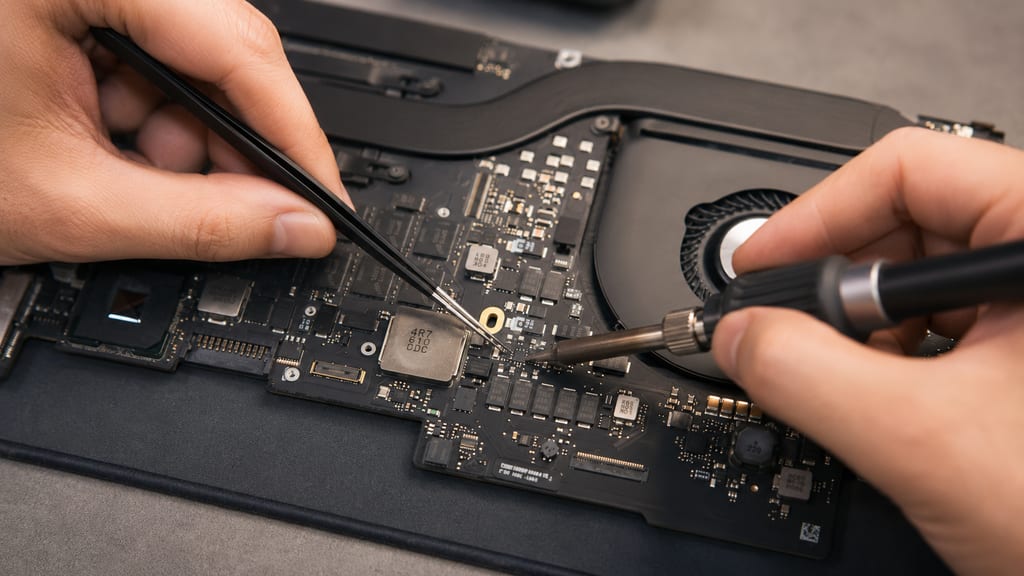
What Logic Board Repair Actually Is
There are two very different things a shop can do with a failed MacBook logic board. It can replace the whole board, or it can repair the one component that actually failed. Apple and authorized shops do the first. We do the second. We have traced what looked like a dead board down to a single failed component more times than we can count.
This is the kind of board-level repair people usually have to mail across the country to find. We do it in-house in Wicker Park, so you can walk your machine in and skip the shipping and the mail-in queue.
Board replacement
What Apple and authorized shops do
- The entire board is swapped out for a new one
- The data on your original board is gone with it
- On modern machines, the storage keys leave with the old board
- Cost typically runs $700 to $1,500
Component repair
What we do
- We identify the specific component that failed
- We replace or rework that part only
- Your original board stays in the machine, so your data stays put
- Cost is a fraction of a full board replacement
We repair around 85% of the board-level machines that come in. The other 15% are damage too severe to be worth it, or cases where the repair would cost more than the machine is worth. When that is the call, we tell you straight.
What Fails on a Logic Board
Board-level failures are not mysterious once you know the patterns. These are the ones we see most, what actually fails, and what fixing it involves.
Charging circuit failure
The power management IC or charging IC that negotiates power and steps voltage up to boot the machine has failed, often after a cheap third-party charger pushed voltage the board was never built to take. The MacBook looks dead. It is one chip.
USB-C controller failure
On USB-C models the controller that handles the charger handshake fails and the machine never gets the signal to power up. On these boards that part is the CD3217 or CD3215. Replace it and the power path comes back.
Backlight circuit failure
The board's backlight circuit fails and the screen stays black or shows only a faint glow you can just make out under a flashlight, even though the MacBook is running. It is a board-level repair, not a new display, which keeps it far cheaper than a full screen replacement.
Liquid corrosion
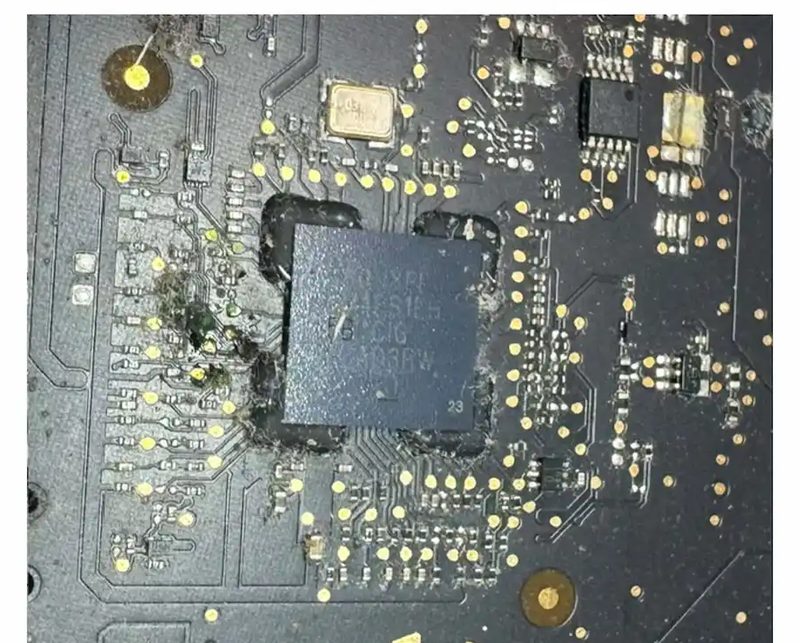
Liquid that reached the board corrodes traces and shorts components. It needs to be evaluated before any repair begins. Board-level liquid repair is its own assessment, covered on our MacBook liquid damage repair page.
Blown capacitors or MOSFETs
A failed part drags a power rail to ground and the board will not boot. We feed a small, controlled current into the shorted line and watch what heats up. Most of the time it is a single shorted capacitor. We pull it, the short clears, the board comes back.
EFI / firmware corruption
Sometimes the board is fine and the firmware is scrambled. We handle EFI chip repair and firmware recovery, and a no-boot diagnosis tells us whether the fault is hardware or software before any parts are touched. T2 and Apple Silicon diagnostics are part of the same bench work.
Why Apple Quotes a Replacement
When Apple quotes a logic board replacement, they are not telling you the board is beyond repair. They are telling you they do not do board repair. Those are different things.
Authorized status means following Apple's repair policy, and that policy is a full board swap, no component-level work. The referral chain runs the same way: Apple sends the machine to an authorized reseller, and the reseller follows the same policy. A lot of shops default to full board replacement because component-level work takes specialized skill and equipment. We do that work in-house, which is why we can offer what authorized shops cannot.
The price reality
Out-of-warranty board replacement commonly runs $800 to $1,200, higher on M-series and 16-inch machines. That is a full swap, not a repair, and the data tied to your original board goes with it.
A targeted component-level repair often fixes the same fault for a few hundred dollars. The exact number comes after the diagnostic, once we know what failed. We show you the logic before you decide.
Real case
A water bottle opened in someone's bag and soaked the MacBook. Apple shipped it out, two weeks later quoted a full board replacement at about the price of a new machine. They brought it to us instead. We did a board-level repair, replaced the components the liquid had actually damaged, and returned the machine with all data still there, for a fraction of what a full swap would have cost.
Data and Logic Board Repair
Component repair keeps your original board in the machine, so the data tied to it stays where it is; a full board swap is what takes your data with the old board. If your main concern is the data itself rather than the repair, our MacBook data recovery page walks through exactly how that works and what it costs.
Every Model, Every Generation
We service every MacBook: Intel, T2, and Apple Silicon machines from M1 through M5, MacBook Air and MacBook Pro, including models the manufacturer no longer supports. There is no cutoff date here. Models the big-box stores and authorized shops turn away for being too old, we accept. If you were sent away because the machine is out of support, bring it in.
What to Expect
-
Walk in, no appointment
A real technician looks at your machine the same day, in the store.
-
$80 board-level diagnosis
We find exactly what failed in 2 to 3 business days, because locating one failed component on an otherwise-good board is measurement work, not a parts swap. The $80 applies toward your repair if you go ahead.
-
Full quote before any work begins
We tell you the exact cost once we know what failed. You decide before we touch anything. No pressure, no obligation.
-
Repair and return
Board repair usually takes another 2 to 4 business days after the diagnostic, up to about a week total depending on severity and parts. We give you a clear timeline and contact you when it is ready.
Board-level repairs typically carry a 30 to 90 day warranty on parts and labor. Coverage is confirmed at the time of service based on the nature of the repair.
Getting Here
We are at 1719 W North Ave in Wicker Park, a short walk from the Damen Blue Line stop. We see customers from across Wicker Park and Lincoln Park, and plenty who come up from the Loop and South Loop. A straight Blue Line ride or a quick drive, with parking that is actually open when you get here.
Transit
- Blue Line: Damen stop, short walk north to North Ave
- Bus: #72 North Ave, #50 Damen, #56 Milwaukee all serve the corner
- Bike: The 606 trail and Milwaukee Ave bike lane
By Car
- From downtown: Kennedy Expressway (I-90/94), North Ave exit
- Parking: Easy street parking on North Ave, usually a spot right out front. None of the downtown circling.
Hours: Monday through Saturday, 10 AM to 5:30 PM. Closed Sundays. Walk-ins welcome, no appointment needed.
Real Repairs From Our Bench
Chicago Has Trusted eRepair Since 2011
"Would have had to pay over $1000 elsewhere. The repairs were done within a day of dropping off my laptop."
Jennifer L. · Google review
"They fixed the battery of my MacBook and it works perfectly. Saved me from investing in a new one."
Di · Google review
Over 15 years of board-level repair experience in Wicker Park, featured in Martha Stewart, U.S. News, and Illinois PIRG.
Common Questions
- It means we find the specific component on your logic board that failed and replace just that part, instead of swapping the entire board. Apple and most shops replace the whole board because component-level work takes specialized skill and equipment. We do that work in-house. Your original board stays in the machine, which means your data stays with it.
- Usually not. A replacement quote tells you Apple replaces boards. It does not tell you the board is beyond repair. Those are different things. Authorized shops swap the whole board because their policy does not include component-level repair. We repair the failed component on boards that were quoted for full replacement regularly.
- Yes, in the vast majority of cases. Component repair keeps your original board in the machine, and on modern MacBooks the storage is tied to that board. Fix the board, the data comes back. A full board swap is what puts your data at risk, because it leaves with the old board. If your main concern is the data itself, see our MacBook data recovery page.
- It starts with an $80 board-level diagnosis that tells you exactly what failed, and it applies toward your repair if you go ahead. The repair itself is quoted after that, once we know what it needs. For comparison, Apple's full board replacement quotes typically run $700 to $1,500. A targeted component repair often fixes the same fault for a fraction of that.
- Board-level diagnostics take 2 to 3 business days, because finding one failed component on an otherwise-good board is measurement work, not a parts swap. The repair itself is usually another 2 to 4 business days after that, up to about a week total depending on severity and whether parts are needed. We give you a clear timeline once we have measured it. We never quote same-day for board-level work.
- The common ones: charging circuit failures in the power management and charging ICs, USB-C controller failures, backlight circuit faults, corrosion from liquid, blown capacitors and MOSFETs, and EFI or firmware corruption. We also handle EFI chip repair, no-boot diagnosis, and CPU/GPU diagnostics to tell you exactly what failed. If the board can be brought back at the component level, that is the work we do.
- Yes. We service every generation, including Intel, T2, and Apple Silicon machines from M1 through M5. T2 and Apple Silicon diagnostics are part of what we do. There is no model we turn away for being too new or too old.
- Board-level repairs typically carry a 30 to 90 day warranty on parts and labor. Coverage is confirmed at the time of service based on the nature of the repair. Complex board work can vary, which is why we confirm the exact terms when you approve the repair.
- No. Walk-ins are welcome Monday through Saturday, 10 AM to 5:30 PM, at 1719 W North Ave in Wicker Park. Bring it in whenever works for you and a real technician will look at it. You get a straight answer, no appointment required.
- Yes, in most cases, because the data is usually still on the board, locked behind hardware that will not power on. Getting the board working again is what makes the files reachable. If data is your only goal and the machine is otherwise not worth repairing, our MacBook data recovery page covers that path in detail.
- Board repair means we fix the specific component that failed and leave your original board, and your data, in the machine. Board replacement means a brand new board: the original and everything tied to it is gone, and the cost runs $700 to $1,500. Repair preserves your data and usually costs a fraction of a swap. Replacement is the default only because most shops do not do component-level work.
- Component-level repair. We diagnose the board, isolate the exact component that failed, and replace just that part with microsoldering, on our own bench in Wicker Park. Nothing gets mailed out, and you do not wait in a queue for a board swap somewhere else. That is the board-level work most shops send away, and it is what we do in-house, walk-in.
- Yes. Liquid damage is its own assessment, because the damage is often spread across more than one area and has to be evaluated before any repair. We handle board-level liquid repair regularly. For what that process involves and how to give your machine the best chance, see our MacBook liquid damage repair page.
Before You Pay for a New Board, Let Us Find the Component
We tell you exactly what failed and what it costs to repair before you commit. No pressure, no obligation.